School of Animation and Digital Arts Communication University of China
| 中国传媒大学 | |
 | |
| Erstwhile names | Beijing Broadcasting Institute (1959 - 2004) |
|---|---|
| Motto | 立德、敬业、博学、竞先 (Chinese) |
| Motto in English | Integrity, Professionalism, Erudition and Competence |
| Type | National |
| Established | 1954 (1954) |
| President | Liao Xiangzhong |
| Academic staff | 1115 |
| Students | 14,623 |
| Undergraduates | 9452 |
| Postgraduates | 5171 |
| Location | Beijing China |
| Campus | Urban 463,700 thoutwo (4,991,000 sq ft) |
| Website | en |
The Communication University of China (CUC) (Chinese: 中国传媒大学; pinyin: Zhōngguó Chuánméi Dàxué ) is a leading public university in Beijing. It is one of the China's fundamental universities of 'Double First Class University Programme', directly administered past the Ministry of Education of the Communist china. CUC developed from what used to be a training center for technicians of the Fundamental Broadcasting Bureau that was founded in 1954. In April 1959, it was upgraded to the Beijing Dissemination Constitute (BBI) (Chinese: 北京广播学院; pinyin: Běijīng Guǎngbō Xuéyuàn ) approved past the Country Quango. In August 2004, BBI was renamed Communication University of Cathay. CUC is located in the eastern part of Beijing near the ancient culvert, which occupies 463,700 square meters of country and a total of 499,800 square meters of buildings.[1]
History [edit]
CUC's history dates dorsum to March 3, 1954 when the first preparation class for broadcasting professionals was held by the then Central Radio Administration. This so led to the founding of Beijing Broadcasting College in 1958. On September vii, 1959, CUC'southward precursor Beijing Broadcasting Institute (BBI) was established. During the ensuing four decades, BBI remained a relatively small college and but known amid the circles of Chinese media professionals.[ citation needed ]
On August 19, 2004, the State Quango of the People's Republic of Prc approved the renaming of the institute to the Communication University of China. Information technology has at present developed into a comprehensive constitute of higher learning with broadcasting, film production, journalism, drama, animation, advertising, newscasting, creative cultural industry, Communications engineering science, foreign languages (specially minority linguistic communication), management and media constabulary education as its major academic disciplines.[ii]
Academics [edit]
Overall academic state of affairs [edit]
CUC upholds its ideology of offering courses that are centered on scientific based learning by emphasizing the application of a course and relevance to the detail discipline. As a result, an inter-relating and inter-influencing bailiwick system that covers journalism and communication, moving-picture show and television arts, data science and engineering, literature, applied science, management, economics, and police and science has been formed. At that place are currently half dozen faculties that consist of one co-innovation eye and five directly affiliated schools, which comprise two national cardinal disciplines (journalism and radio and television arts). There is also one national central cultivation field of study (communication), three Beijing municipal cardinal disciplines (journalism and communication, fine art theory, theater film and television), four Beijing municipal fundamental subordinate disciplines (linguistics and practical linguistics, communications and information systems, electromagnetic field and microwave engineering, animation), 7 post-doctoral research centers, 7 doctoral programs, 35 doctoral programs (subordinate disciplines), 18 master programs, 95 master programs (subordinate disciplines), 8 professional master categories, and 84 bachelor programs.[3]
Faculties and schools [edit]
Faculty of Journalism and Communication
- TV School (From 2004 to 2013, Tv School and the School of Journalism were temporally merged into the School of Television and Journalism.)
- School of Journalism
- Institute of Advice Studies
Faculty of Art
- School of Moving picture and Cinematic Arts
- Schoolhouse of Animation and Digital Arts
- School of Music and Recording Arts
- Schoolhouse of Presentation Art
- Institute of Art
- Art Education Center
Kinesthesia of Science and Technology
- Information Technology School
- Schoolhouse of Science
- School of Computer Scientific discipline
- Experimental Instruction Center
Kinesthesia of Literature and Law
- School of Literature
- School of International Studies
- School of Teaching Chinese as Foreign Language
- Sports Department
Kinesthesia of Ad, Economic science and Management
- Advertising School
- School of Economics and Management
- Business School
- Culture Development Plant
Advice Strategy of People's republic of china Co-innovation Center
- New Media Institute
- Institute of Media Science
Kinesthesia of Continuing Education
- School of Altitude Learning and Continuing Education
- School of Executive Education and Professional Grooming
- Vocational and Technical School
- Academy of Media and Public Affairs
- Phoenix School
Independent Schools and Departments
- School of Government and Public Affairs
- Schoolhouse of Marxism
- International Communication University of China (ICUC)
- Computer and Network Center
- Practical and Experimental Educational activity Center (CUCTV)
Confucius Institutes [edit]
Communication University of People's republic of china has co-established three Confucius Institutes for providing Chinese linguistic communication and cultural education for learners exterior of Red china.
- Belgrade Confucius Found (in cooperation with University of Belgrade, Serbia)
- Groningen Confucius Institute (in cooperation with University of Groningen, Hanze University of Applied Sciences Groningen, and the Municipality of Groningen.)
- Confucius Institute at Federal University of Rio Grand Practise Sul (in cooperation with the Universidade Federal exercise Rio Grande do Sul, Brasil)
Modernistic foreign languages pedagogy [edit]
Communication University of Red china is one of the officially-sanctioned important base in China for education foreign languages and especially narrowly-used languages. Then far, CUC has successively offered 32 Available'south programmes in modern foreign languages since its establishment.[4] Some of programmes recruit students irregularly every few years according to admission plans sanctioned by the Ministry of Education. CUC is nevertheless the only academy in China to offering Bachelor'southward programmes in Bengali, Tamil, Pashto and Esperanto.

The Schoolhouse of International Studies
English (since 1958), Spanish (since 1959), French, Russian, High german, Japanese, Korean, Portuguese (since 1960), Italian (since 1960), Hindi (since 1965), Bengali (since 1964), Nepali (since 1964), Assamese (since 1965), Urdu (since 1962), Tamil (since 1959), Sinhalese (since 1965), Pashto (since 1964), Persian (since 1988), Zulu (since 1965), Swahili (since 1960), Esperanto (since 1959), Turkish (since 1959), Swedish, Hausa (since 1965), Malay, Hebrew, Greek (since 1964), Hungarian, Dutch (since 1965), Laos (since 1965).[five]
Rank [edit]
Communication University of China is widely regarded as one of the most competitive universities for admission in China.[6] [7] [8]
In September 2017, CUC was selected as one of 140 Double First Grade Academy Programme universities approved past the Ministry of Education.[9]
In the fourth round of China University Subject Rankings (CUSR) by the Chinese Ministry building of Education in 2018, Communication Academy of China ranked 1st in mainland People's republic of china with its 2 disciplinary areas evaluated equally A+ disciplines, including "Journalism and Communication" and "Drama, Picture show and Television Studies" and ranked 3rd with A− in "Art Theory", 10th with B+ in "Design", 19th with B in "Fine Arts" in People's republic of china.[x]
Campus location [edit]
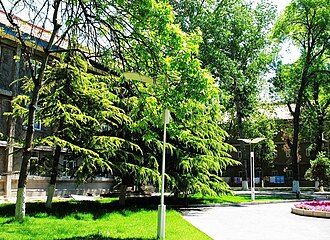
CUC's 116.88 hectare chief campus is located in Dingfuzhuang, eastern office of Chaoyang District, Beijing. It is simply outside the Eastern fifth Ring Route, and is but along the Beijing-Tong County expressway. The campus is linked by the Communication University of China Station of Beijing subway Batong Line.
-

Main Building
-

Cultural Square
-

Old Apartment for Young Staff Members
-

No. ane Didactics Building
-

Playground
-
Student Dormitory
-
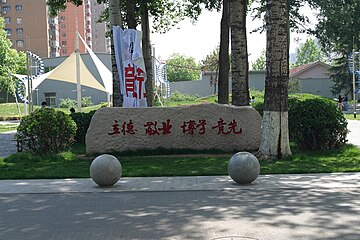
motto
-
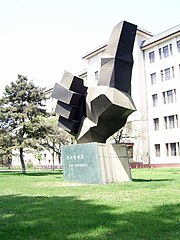
Sculpture: Our Alma mater
Affiliations [edit]
- Communication University of Communist china Press
- Communication Academy of Mainland china, Nanjing
Established in 2004, CUCN is an independent private university in the southern city of Nanjing, Jiangsu Province. It is straight supervised by the lath of directors, with CUC's one-time president as the honorary caput of the board.
Notable alumni [edit]
Advice University of China is known for fostering media administrators, producers, journalists and Television receiver presenters in China. Some of its notable alumni include:
Media administrators [edit]
- Liu Changle: Chairman of Phoenix Satellite Television based in Hong Kong.
- Wang Jiyan: VP of Phoenix TV Hong Kong and caput of the Phoenix Chinese Channel.
- Yang Hongxin: Director of Xinjiang Idiot box
Media celebrities [edit]
- Luo Jing, news presenter from China Primal Goggle box
- Cui Yongyuan, television host from China Key Television set
- Bi Fujian, tv host from China Fundamental Television
- Chen Luyu, a Phoenix Television set talk bear witness host.
- Li Yong, television host from China Key Television
- Bai Yansong, news presenter from China Key Tv set
- Chai Jing, one-time journalist from Prc Primal Television
- Chen Luyu, host from Hong Kong's Phoenix Television
- Zhang Haijie, news presenter from Singapore's MediaCorp Aqueduct viii
- Chen Xiaonan, a Phoenix Television talk show host.
- Li Xiang, actress, telly host and vocalizer.
- Alex Man, Hong Kong actor
- Dong Zhen, singer-songwriter
- Sandra Ma, television and movie actress
- Zining, singer-songwriter, Rocket Girls 101'southward member
- Li Yi, narrator and voice thespian.
- Fu Yaning, singer and actress
References [edit]
- ^ "Introducing CUC". en.cuc.edu.cn . Retrieved 2019-05-01 .
- ^ "History & Tomorrow". Archived from the original on 18 November 2011. Retrieved eight Nov 2011.
- ^ "Introducing CUC". en.cuc.edu.cn . Retrieved 2019-05-01 .
- ^ "中国传媒大学本科招生网-专业介绍". zhaosheng.cuc.edu.cn . Retrieved 2019-05-02 .
- ^ "===历届校友===". web.archive.org. 2017-07-22. Retrieved 2019-05-02 .
- ^ "用大数据告诉你2018年中国传媒大学将会有多难考". www.sohu.com . Retrieved 2019-05-01 .
- ^ "国内最难考的10所大学,每年还有一大批人挤破脑袋都想进!". baijiahao.baidu.com . Retrieved 2019-05-01 .
- ^ "2018年中国重点高校录取难度排名,就是这些学校最难考". world wide web.sohu.com . Retrieved 2019-05-01 .
- ^ ""双一流"建设高校和学科名单公布—新闻—科学网". news.sciencenet.cn . Retrieved 2019-05-02 .
- ^ "Red china University Subject Rankings (CUSR)". www.chinadegrees.cn . Retrieved 2019-05-01 .
External links [edit]
- Campus real three-dimensional map
Coordinates: 39°54′33″N 116°33′01″E / 39.909106°North 116.550162°E / 39.909106; 116.550162
Source: https://en.wikipedia.org/wiki/Communication_University_of_China
0 Response to "School of Animation and Digital Arts Communication University of China"
Postar um comentário